

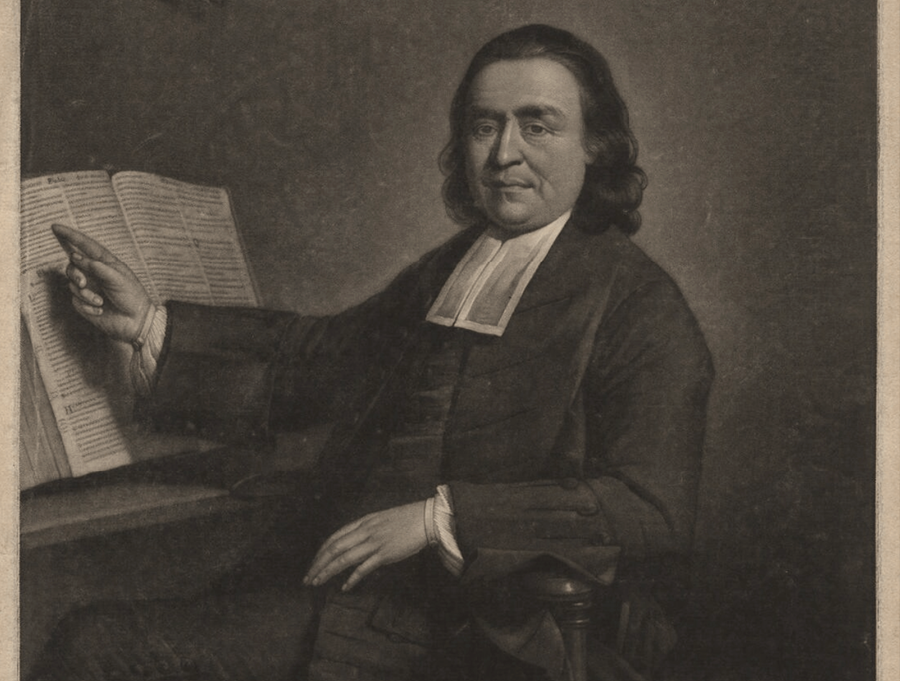
Phillis Wheatley and Reverend Samson Occom
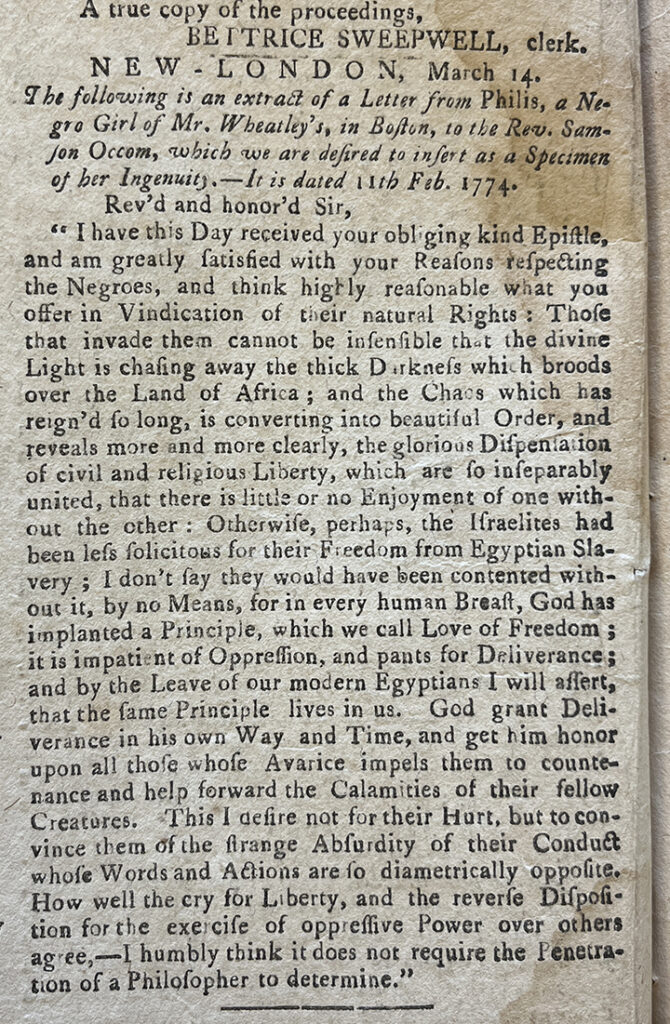
The letter from Phillis to the reverend, which he submitted to the The Connecticut Gazette, which published it in April, 1774
Click here to see a closeup of the top part of that issue of the paper
https://cathysturningleaves.com/wp-content/uploads/2025/07/Newport-Mercury-April-11-1774-big-scaled.png
The images are incomplete, but here is the text:
Rev’d and honor’d Sir,
I have this Day received your obliging kind Epistle, and am greatly satisfied with your Reasons respecting the Negroes, and think highly reasonable what you offer in Vindication of their natural Rights: Those that invade them cannot be insensible that the divine Light is chasing away the thick Darkness which broods over the Land of Africa; and the Chaos which has reign’d so long, is converting into beautiful Order, and [r]eveals more and more clearly, the glorious Dispensation of civil and religious Liberty, which are so inseparably Limited, that there is little or no Enjoyment of one Without the other: Otherwise, perhaps, the Israelites had been less solicitous for their Freedom from Egyptian slavery; I do not say they would have been contented without it, by no means, for in every human Breast, God has implanted a Principle, which we call Love of Freedom; it is impatient of Oppression, and pants for Deliverance; and by the Leave of our modern Egyptians I will assert, that the same Principle lives in us. God grant Deliverance in his own Way and Time, and get him honour upon all those whose Avarice impels them to countenance and help forward tile Calamities of their fellow Creatures. This I desire not for their Hurt, but to convince them of the strange Absurdity of their Conduct whose Words and Actions are so diametrically, opposite. How well the Cry for Liberty, and the reverse Disposition for the exercise of oppressive Power over others agree, —
I humbly think it does not require the Penetration of a Philosopher to determine.
=========================
Occom, Samson (1723-1792)
Native American pastor and missionary
occomOccom was born at Mohegan, Connecticut, and became a Christian in his youth. He was the first Indian trained by Eleazar Wheelock at his school in Lebanon, Connecticut, which later became Dartmouth College. In 1749 he moved to eastern Long Island to be teacher and pastor to the Montauk people. His success there led to his ordination by the Long Island Presbytery in 1759, even though he lacked theological education.
Occom made two mission trips to the Oneida Indians in upstate New York, and in 1765, a trip to England with Nathaniel Whitaker to raise funds for Wheelock’s school. He made a great impression in England and with Whitaker raised over £12,000. After his return he became an itinerant preacher to the New England Indians and was sometimes in poverty. He was a leader in resisting the encroachments by whites on Indian lands, which made him unpopular in Connecticut. He also took a lead in securing lands for the settlement of New England Indians among the Oneida, who were far from white influence. In 1785, when Brothertown was established in Oneida territory, he became its pastor and remained there the rest of his life.
He was a great orator who gave little attention to doctrine but much to rules of conduct. He composed a number of hymns and published a hymn collection that went through three editions.
==============================
=============================
In 1765, when Phillis Wheatley was about eleven years old, she wrote a letter to Reverend Samson Occum, a Mohegan Indian and an ordained Presbyterian minister. Despite the difference in their ages (Occum was born in 1723), Wheatley’s letter apparently led to a friendship with Occum, who was also a poet, and who later published an Indian hymnal.
On February 11, 1774, Wheatley wrote Occum again, to comment on an indictment of slave-holding Christian ministers that he had written. Wheatley strongly concurred with the argument put forth by Occum, writing that she was “greatly satisfied with your Reasons representing the Negroes” and thought “highly reasonable what you offer in Vindication of their natural Rights.” While she implored God’s deliverance from “those whose Avarice impels them…” she hastened to add, “This I desire not for their Hurt, but to convince them of the strange Absurdity of their Conduct whose Words and Actions are so diametrically opposite.”
————————
A newspaper advertisement indicates that Samson Occom sold copies of Phillis Wheatley’s Poems on Various Subjects, Religious and Moral. 1773. Advertisement, Connecticut Gazette, June 17, 1774. Public Domain.
https://cathysturningleaves.com/wp-content/uploads/2025/07/Occams-ad.png
————————–
Phillis Wheatley and Reverend Samson Occom, both writers and advocates for freedom, engaged in a significant exchange of letters, particularly concerning the issue of slavery. Wheatley, a formerly enslaved poet, corresponded with Occom, a Mohegan Presbyterian minister, starting in 1765 when she was just eleven years old. Their correspondence highlights their shared concerns about the hypocrisy of a nation demanding liberty while perpetuating slavery.
Here’s a more detailed look at their relationship:
Early Correspondence:
Wheatley and Occom’s relationship began with letters in 1765, when Wheatley was a young girl.
Shared Concerns:
Both Wheatley and Occom were deeply troubled by the institution of slavery and the contradiction between the ideals of liberty and the reality of enslavement.
Occom’s Advocacy:
Occom, a prominent figure in the Great Awakening and the first Native American to publish an autobiography, was known for his sermons against slavery. He even suggested that Wheatley, like Quaker women, could preach to her people.
Wheatley’s Letter:
In a 1774 letter to Occom, Wheatley explicitly condemned ministers who owned slaves, highlighting the hypocrisy of those who preached freedom while oppressing others. She also emphasized the inherent human desire for freedom, stating that it is “impatient of oppression”.
Publicity:
Wheatley’s letter to Occom was published in the Connecticut Journal, bringing her powerful message to a wider audience.
Shared Experiences:
Both Wheatley and Occom, despite their different backgrounds (Native American and African), were intellectuals and writers who navigated the complexities of race and freedom in colonial America.
https://massachusetts250.org/wp-content/uploads/2024/11/Phillis-Wheatley-Cover-Photo-Credit-FRIENDS-OF-THE-PUBLIC-GARDEN-scaled.jpg
Their correspondence and shared experiences offer valuable insights into the social and political landscape of the late 18th century, particularly the tensions surrounding slavery and the fight for liberty.
=============================
=============================
Wheatley had exchanged letters with Occum beginning in 1765, when she was only 11 years old. Occum, who was 30 years her senior, was an itinerant preacher who first converted to Christianity during the Great Awakening and became the first Native American to write an autobiography. Able to read and speak in Latin, Greek, and Hebrew, Occom surely would have been a beacon to the young Wheatley, who had embarked on an unusual education in the Bible, English literature, and Greek and Latin classics.
Wheatley’s poetry often celebrated profound love for the nascent country yet castigated it for its backwardness in perpetuating the institution of slavery. Thick with Biblical allusions, Wheatley’s writing often also urged the country to reckon with whether it was living up to Christian principles.
In the letter published by the Connecticut Journal, Wheatley casts shame on the enterprise of slavery by boldly comparing enslavement in America to pagan ancient Egypt: “perhaps, the Israelites had been less solicitous for their Freedom from Egyptian Slavery: I don’t say they would have been contented without it, by no Means, for in every human Breast, God has implanted a Principle, which we call Love of freedom; it is impatient of Oppression, and pants for Deliverance; and by the Leave of our modern Egyptians I will assert that the same Principle lives in us.”
Wheatley wrote about her desire to convince revolutionary colonists of “the strange Absurdity of their Conduct whose Words and actions are so diametrically, opposite.”
The newspaper reprint will join a signed first edition copy of Wheatley’s 1773 collection Poems on Various Subjects, Religious and Moral — the first book of poetry by an African American woman — which is currently also on view at the Museum of the American Revolution.
“What was so powerful for us for this newspaper printing of this letter is it’s a correspondence between two people of color on the eve of the outbreak of the war, reflecting on the great contradiction that’s at the heart of the founding, which is a struggle for liberty, in an era in which chattel slavery is still practiced,” President of the Museum of the American Revolution Dr. R. Scott Stephenson told Hyperallergic. He called it “unusual” for a newspaper at the time to publish writing like this in its pages.
=======================
Tanner?
Another potential reason for the connection between Wheatley and Newport is Obour Tanner, a frequent correspondent of Wheatley’s who would become a leader in Newport’s free African community. The two carried on a correspondence for years, but only a handful of Wheatley’s letters to Tanner survive (these will be the focus of my next blog post). The circumstances of her friendship with Wheatley raise more questions than answers: How did they first come into contact? Did they ever meet in person? To what extent were Tanner’s enslavers aware of her correspondence with Wheatley — and to what extent did they foster or discourage such open and frequent communication?