

The Odd Case of Oxford U vs. Henry Symeonis
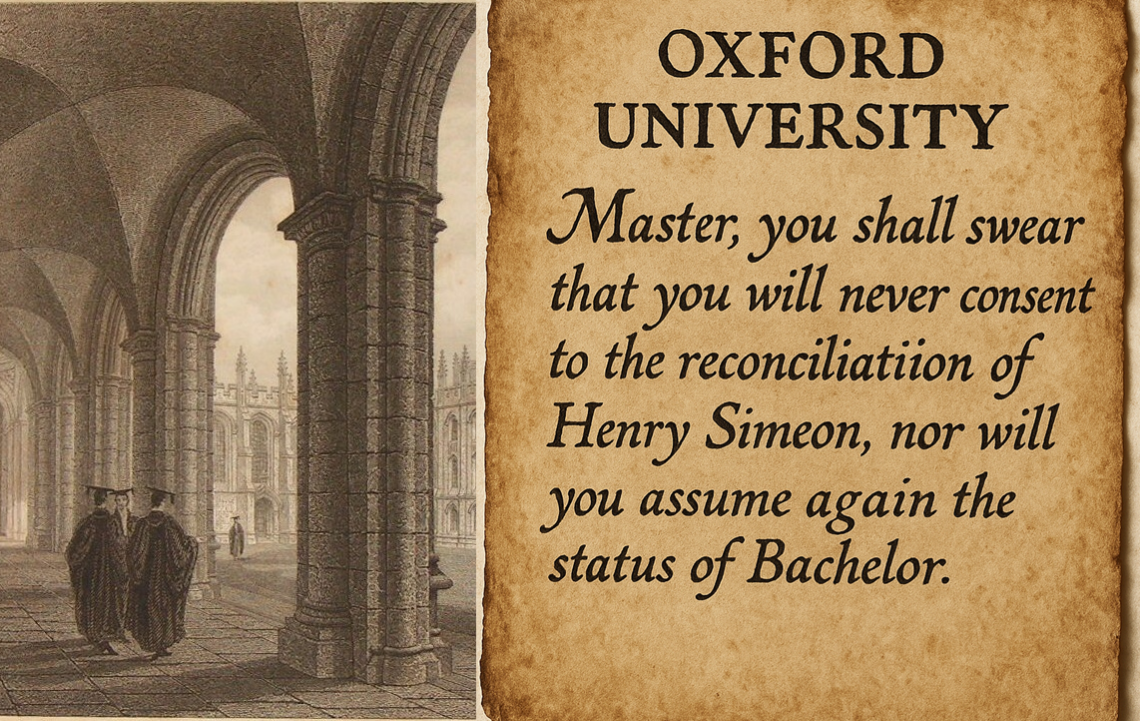
Beginning in 1264, anyone receiving a Master of Arts degree from Oxford University had to swear they would never forgive Henry Symeonis. This requirement was lifted in 1827, but by then, it had been a few hundred years since anyone knew who Henry Symeonis and why students were taking an oath against him.
How it Started
The year was 1242. Nobody knows what precipitated the act of violence, but a man named Henry Symeonis, along with a group of other people, murdered an Oxford University student. Rather than jail them, King Henry III fined Henry and his accomplices £80 and ordered them to leave the town of Oxford.
22 years later, in 1264, Henry’s father somehow convinced the king to pardon his son. He happened to be a very wealthy man, and many historians speculate that he may have bribed the king.
Not only did the king pardon Henry, he also ordered the town of Oxford to allow him to return. After all, the elder Mr. Symeonis had most of his business interests in the town of Oxford, and it was rather inconvenient that his son had been unable to help tend to them for the previous 22 years.
This pardon infuriated the University. They were helpless to openly defy the king’s order, but they found a rather unique way to flout it.
They embedded the name of Henry Symeonis in their own statutes in the manner of an oath. The statutes were, and still are, the written set of rules and regulations which govern all University proceedings.
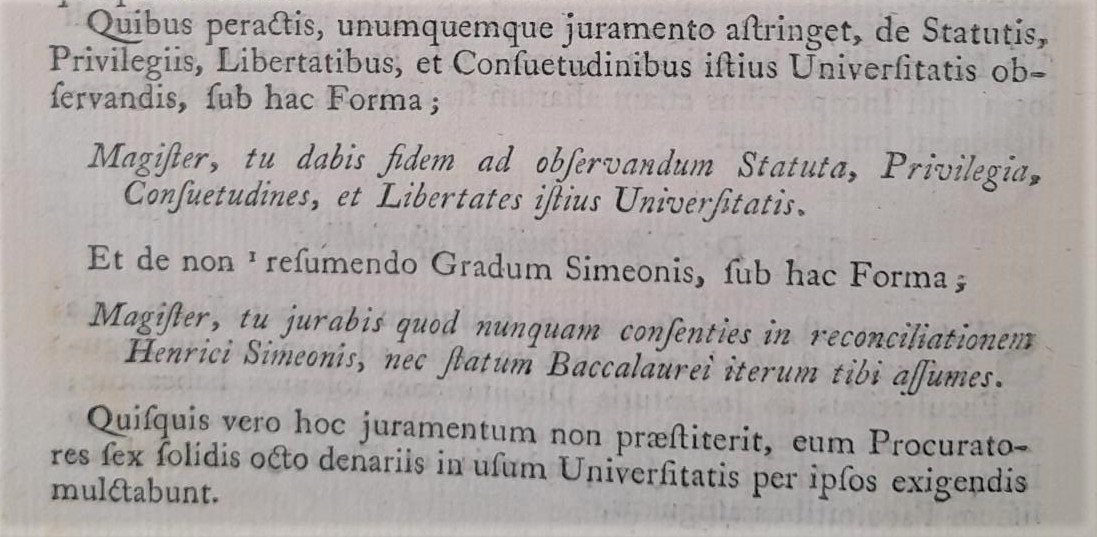
In those days, official oaths were taken in Latin, and thus the oath read as: “Magister, tu jurabis quod nunquam consenties in reconciliationem Henrici Simeonis, nec statum Baccalaurei iterum tibi assumes“, which translates to “Magister, you will swear that you will never consent to reconciliation with Henry Symeonis, nor will you again assume the status of baccalaureate”.
For the next few centuries, every student seeking a Master of Art’s degree at Oxford University was required to take that oath.
How it Continued
As the decades and centuries passed, the reason for the oath faded from the collective memory. For more than 560 years, art student graduates had to take the oath against Henry Symeonis without knowing why, or who he was. Even the University forgot the reason for the oath, but it had become so entrenched in the graduation ritual, that it was mindlessly reiterated, year after year.
Around the mid 1600s, Oxford University undertook a review of their statutes. The Henry Symeonis oath came into question, and it was proposed that it be removed. But since nobody knew who that was, or why there was an oath against the man, the committee decided it might be important, and it was best to leave it in place.
How it Ended
In 1827 the University commenced another major review of its statutes. Once again, they were confronted with the rather peculiar swearing-in oath required by students pursuing a Master of Arts degree.
The details of the committee’s reasoning has been lost to history, but this time they decided to remove the oath. It’s not known whether they determined who Henry Symeonis was or why there was an oath against him, but they concluded it was time to abolish it.
The story is not over quite yet:
In 1912, a man named Reginald Lane Poole was serving as the Keeper of the University Archives, when he came across a copy of the Henry Symeonis oath. Overcome by curiosity, this was a mystery he resolved to unravel.
Poole was a skilled historian and researcher, and sought out old University archives, as well as forgotten town records and property deeds. Slowly, but surely, he pieced together the entire story.
It’s thanks to Mr. Poole that we now know who Henry Symeonis was, and why there was an oath against him.
Detail of the Henry Symeonis oath from the Corpus Statutorum, the oaths required of those seeking a Master of Arts.


More Great Stories by Cathy

Nature’s Light Show

JoAnn Morgan, Aerospace Engineer

12 Comments
Beth
Stories like this are always so interesting to me. I love getting a look at the lore behind things like this. Great read.
Amber Myers
This was such a cool read. I love history, so this is pretty neat. I hadn’t known about it at all.
Rosey
It’s amazing how things get entrenched in habit and we have no good understanding of what it means. Awesome when someone takes the time to figure out the true meaning behind it.
Alejandra
Such an interesting story. I didn’t know about this case. History really has so many odd stories!
Carol Cassara
I love these little historical oddities, usually attributed to other countries. At least someone figured it out so that it wouldn’t remain a mystery forever!
jerry godinho
What a delightfully bizarre piece of Oxford lore, equal parts history and institutional ghost story. It shows how old grievances can outlive meaning and become curious institutional echoes over time.
LisaLisa
WOW, now this is one of those strange history stories you could never make up. It’s wild to think students had to swear an oath against someone for hundreds of years without even knowing who he was or why. Thank goodness for curious historians because I would have wanted answers too!
Melanie E
This is a reminder of how institutions preserve rituals long after meaning fades. They turn historical grievances into unquestioned tradition until they are rediscovered later.
Barbara R
Well, that is an interesting story. I think I saw something about this on TV (a movie or something), as the name sounds familiar. But I can’t imagine taking an oath against without knowing why or who he was.
Elizabeth F
I love the power of historical research to unearth the genesis of a story and pull as much factual information together. Poole did a brilliant job and now we have the whole story or, at least, a version of the facts.
Sonia Seivwright
I kept thinking about how many traditions people still repeat without ever knowing where they came from. That detail about students swearing against Henry Symeonis for generations, long after the reason had disappeared, was such a powerful example of how institutions hold on to things. This was such an absorbing piece to read.
Clarice
This is such an interesting read. At first, it may seem extreme to take an oath against someone you do not even know personally, but I can understand why that kind of hatred developed.
A lot of it probably comes from greed, money, and the injustice people feel when it seems like anything can be bought, even pardons that were not truly deserved.